
Case
Kvosted Hybrid Park: turning volatility into value with hybrid renewable energy
Jun 10, 2026

Hybrid renewable energy projects combine solar generation with battery storage to improve flexibility and reduce exposure to volatile power markets. The Kvosted Hybrid Park demonstrates how integrating storage directly into renewable assets can transform market risk into value.
As renewable penetration increases across Europe, ensuring stable and reliable power becomes a defining challenge for modern energy systems. At European Energy, hybrid projects are designed to address this challenge – combining generation and storage in hybrid renewable energy systems to deliver both flexibility and stability.
Europe’s renewable revolution is entering a new phase – one where flexibility, not just capacity, defines success. By 2030, renewables are expected to supply nearly 70% of Europe’s electricity (up from ~50% in 2025).
This rapid shift is reshaping power markets, bringing unprecedented variability, price volatility, and grid bottlenecks. In Denmark alone, the DK1 electricity price zone recorded 521 hours of zero or negative wholesale power prices in 2025, up from 424 such hours in 2024 – stark evidence that surging midday solar and wind output often outpaces demand.
When generation exceeds what grids can absorb, electricity becomes “too cheap to use,” forcing renewable plants offline – curtailment – unless they’d be willing to “pay to produce”. These trends pose a structural challenge: how can renewable projects remain economically resilient when large portions of their output risk being either wasted or sold at untenably low prices?
Adding more generation alone is no longer sufficient; the energy system must evolve to harness that generation when and where it’s needed. This is where battery energy storage systems (BESS) come into play. At Kvosted Energy Park in Denmark, European Energy has demonstrated a scalable solution: integrating large-scale BESS directly with a solar farm to create a single hybrid asset.
Rather than treating storage as a bolt-on, hybrid projects embed flexibility into asset design, actively managing market exposure and transforming volatility from a risk to an opportunity. Hybrid ‘solar + battery’ parks represent a fundamental evolution in how renewables are designed, financed, and operated.
“Hybrid assets actively reshape their revenue profile – they don’t just passively accept market prices.”
The hybrid approach: structural flexibility for volatile markets
In a hybrid renewable project, generation and storage operate as one integrated system behind a shared grid connection. By co-locating battery storage with solar (or wind), the project gains the ability to time-shift energy delivery. When the sun is over-producing and prices bottom out, excess solar output flows into the battery instead of saturating the grid. Later, when demand rises and prices improve (e.g. in the evening), that stored green energy is dispatched from the battery to capture higher value.
This flexibility mitigates downside risks (like curtailment and negative prices) and unlocks upside by monetising price volatility through arbitrage and grid services. Crucially, co-location also maximises existing grid capacity – more output and services are delivered through the same connection point, easing the strain on a congested grid.
Annual storage deployments in Europe reached ~14 GW in 2025 and are projected to exceed 30 GW by 2030, as 14+ countries have incorporated storage into their national energy plans.
Batteries have rapidly moved from niche to necessity – cost declines and policy support are enabling widespread adoption.
For renewable developers and investors, a pivotal question remains: How to keep assets investable in a world of intermittent supply and erratic prices? The hybrid model offers an answer: combine generation with storage to actively shape risk and returns, rather than relying solely on fixed long-term contracts or hoping for stable markets.
“Batteries aren’t optional add-ons anymore – they’re becoming standard in how we build robust renewable projects.”
Flagship case – Kvosted Energy Park: solar + 200 MWh battery
Located in Viborg municipality (Denmark), Kvosted Energy Park is, as of April 2026, Northern Europe’s largest combined solar and storage facility. Originally commissioned in 2022 as a 101 MW standalone solar PV park, it faced mounting market pressure as negative-price hours and grid curtailments spiked in subsequent years.
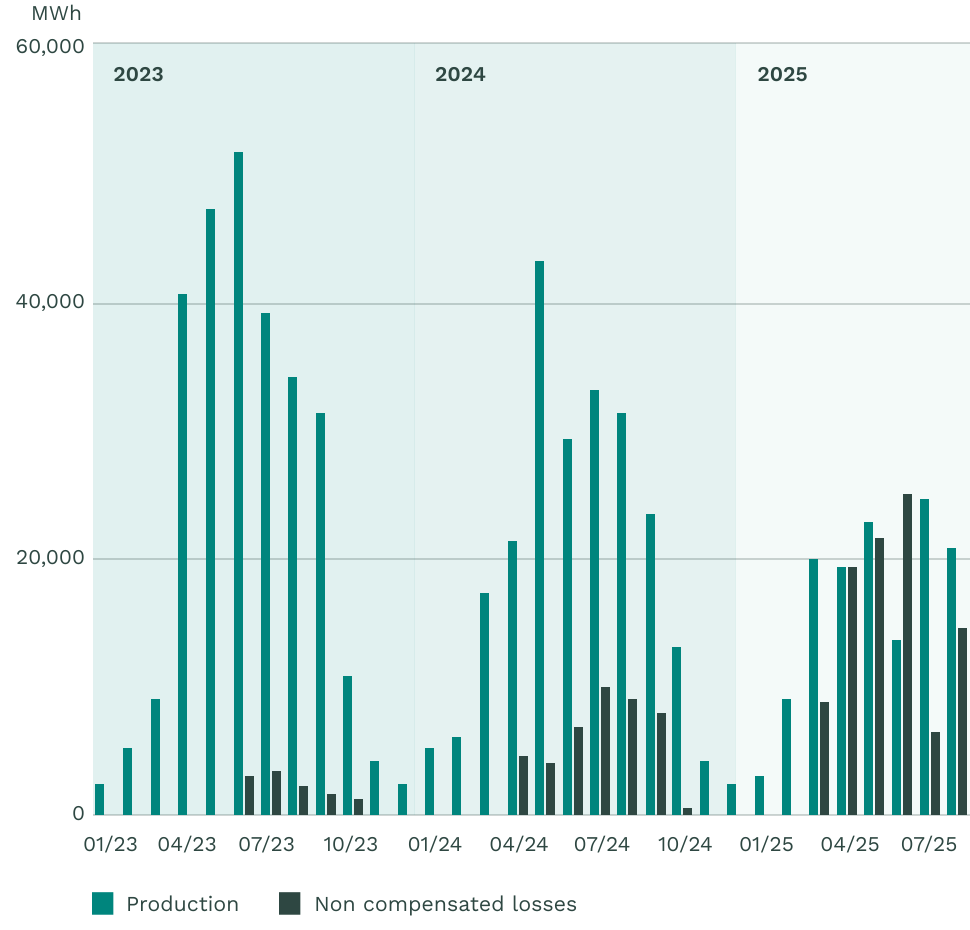
In 2025, a 50 MW / 200 MWh battery system was integrated on-site – transforming Kvosted into a fully fledged hybrid park. Both solar array and battery now operate behind one grid connection, with coordinated controls. The battery charges from surplus solar production (or even from the grid when advantageous, where permitted) and discharges power when prices are favorable or when solar output wanes. Effectively, Kvosted can sell electricity when it’s most needed, not just when it’s generated.
How exactly does this hybrid setup create value? By storing midday oversupply, Kvosted avoids having to curtail or dump cheap power in low-demand hours. Instead, that energy is stored on site before dispatched to the grid—reducing wasted output to near-zero. This provides immediate downside protection: the project is far less exposed to negative prices or forced shutdowns when the grid is flooded.
Next, the battery’s “arbitrage” operations improve Kvosted’s revenue quality – solar electrons that would earn €0/MWh at noon can fetch higher prices in the evening peaks. By shifting a portion of production to higher-value periods, the hybrid park boosts its average capture price and smooths out revenue volatility. This dynamic is sometimes described as a physical hedge against “shape risk” – the risk that a plant generates power at the wrong times. Kvosted’s hybrid configuration removes much of this shape risk: it is no longer forced to sell into unfavorable market conditions.
Moreover, the battery opens new income streams beyond energy sales. Kvosted participates in grid balancing markets – providing ancillary services like frequency regulation and reserve power that support the local electricity system. These services were previously inaccessible to a pure solar farm. By delivering valuable fast-response capabilities, the project earns additional revenue and strengthens grid reliability at the same time. The net effect is a diversified revenue stack: Kvosted still sells renewable energy, but now also gets paid for delivering flexibility.
“At Kvosted, adding a battery transformed midday oversupply from a liability into a lucrative opportunity.”
From a financial angle, these changes are significant. European Energy estimates a substantial uplift in Kvosted’s lifetime economics due to avoided curtailment, improved capture prices, and new battery service revenues.
Importantly, the hybrid model improves the project’s risk profile: revenues become more stable and forecastable since the asset can adapt its output to market conditions. For investors, that means a more bankable asset – combining the steady cash flows of generation with the high growth potential of merchant storage, while mitigating the downsides of each. In other words, hybrid projects fuse the reliability of traditional renewables with the agility of storage, yielding infrastructure that is better equipped to thrive in volatile markets.
From flagship to standard practice
The Kvosted hybrid park is a blueprint for the next generation of renewable investments. By showing that volatility can be actively managed and turned into value, the park validates a model that European Energy is scaling globally. In fact, the company now plans to develop all new solar projects as hybrid configurations where feasible, and has a battery development pipeline exceeding 12 GW across multiple markets.
The momentum extends industry-wide: policymakers and utilities are incorporating storage into planning, and hybrid renewable parks are quickly becoming mainstream as grid connection queues lengthen and market volatility persists.
Ultimately, embedding flexibility at scale is emerging as a repeatable, bankable strategy. Hybrid assets shift renewable projects from passive generators to active participants in the energy market, capable of delivering reliable, on-demand clean power. As renewable penetration soars, this integration of generation and storage will define the new normal for project design and investment. In the era of volatile power markets, hybrid parks demonstrate that the key to unlocking the full value of renewables lies beyond megawatts – it lies in flexibility.
“Hybrid solar-battery parks convert volatility from a threat into an asset – a roadmap for resilient green energy growth.”
Explore more
Read more about hybrid energy systems
Battery energy storage systems (BESS)
Battery energy storage systems (BESS)Previous article on hybrid energy systems
Previous article on hybrid energy systemsSolar and battery in the UK
Solar and battery in the UK